Simplifying Care & Inspiring Hope for Families Living with NF
Medical - B2C - Mobile - Desktop
By blending day-to-day support with long-term optimism, The Meeting Spot becomes a trusted companion for families navigating life with Neurofibromatosis (NF).
Designed to simplify care and strengthen connection, it helps patients and caregivers stay organized, track symptoms, and find hope through shared progress and new discoveries.
The Problem
The Associação Portuguesa de Neurofibromatose (APNF) reached out to UEGroup to design a digital solution addressing the daily challenges faced by people living with Neurofibromatosis (NF) and their caregivers. NF is a complex genetic disorder that causes tumors to form on nerve tissue. It is most commonly diagnosed in children under 10, meaning that caregivers play a long-term, central role in managing care.
People living with NF often see 10 or more medical professionals across multiple specialties (neurology, oncology, genetics, surgery, etc.), and their medical records are scattered across both digital and physical formats. The disease also varies greatly from person to person, and even changes throughout an individual’s life, making it difficult to track symptoms, treatments, and progress consistently.
This fragmented care ecosystem leads to missed information, emotional strain, and limited access to reliable, centralized resources. Patients and caregivers need a single, secure, and empathetic platform to manage records, track health over time, and stay connected to evolving research and community support.
Research & Design Implications
Because NF is most commonly diagnosed in children under 10, the user journey begins with a caregiver, parent or guardian responsible for logging appointments, medications, and symptoms over many years. As the child grows older, the goal is for this caregiver profile to transition ownership, allowing the patient to take over their own health management when they are ready.
Research on NF, stakeholder interviews, and a competitive analysis of tools used to manage NF/chronic illness revealed several critical design implications:
Fragmented Information Ecosystem: Patients rely on multiple disconnected sources—doctors, social media groups, and PDF-based resources—creating confusion and data loss.
Overwhelming Care Coordination: Medical records are both digital and physical, often spread across 10+ professionals, making it difficult to maintain continuity of care.
Highly Variable Disease Experience: NF manifests differently for each person and can evolve unpredictably throughout life, requiring flexible tracking and adaptable information architecture.
Accessibility Needs: NF can affect vision, learning, and cognition, so accessibility and simplicity are essential in both visual design and navigation.
Community as a Lifeline: Facebook groups and informal networks currently fill emotional and informational gaps, indicating a need for integrated, moderated community features.
Empathy & Trust: Beyond functionality, users need an environment that feels compassionate and hopeful—empowering patients and families to take control of their journey.
These insights informed the design approach: build a comprehensive yet human-centered platform that balances medical accuracy with emotional support, and evolves alongside the user’s needs over time.
Key Requirements
Unified Health Management
Centralized hub for medical records, visit summaries, and test results.
Secure sharing between patients, caregivers, and clinicians.
Personalized Patient & Caregiver Dashboards
Separate experiences for patients and caregivers, with the ability to transfer account ownership as patients mature.
Accessibility-conscious design for varying ages and cognitive abilities.
Appointment & Medication Tracking
Link to the user’s preferred calendar app to keep track of appointments.
Set reminders for daily medications.
Symptom Tracking & Insights
Visual logs and trend summaries for symptom progression.
Support for adding notes, photos, and pain ratings to enhance context.
Highlight patterns and connections in symptom tracking, medications, and activities using dynamic data visualizations.
Resource Library & Research Updates
Curated educational materials, clinical trial updates, and new treatment insights from trusted NF organizations.
Community & Emotional Support
Integrated forum or support group space to share experiences safely.
Links to advocacy groups, mentorship opportunities, and local events.
Compliance & Security
Full HIPAA and GDPR compliance for data protection.
Transparent privacy settings and secure cloud storage.
Scalable, Multiplatform Design
Optimized for mobile and tablet use, expand to include desktop version.
Built to expand across languages and regions as community participation grows.
UX Vision
The goal was to create a hopeful, supportive, and empowering experience that connects NF patients, caregivers, and medical professionals in one shared ecosystem, designed to track, manage, and understand health journeys over time.
The app needed to go beyond utility. It had to reduce complexity, bring order to scattered medical data, and instill optimism in users managing a lifelong condition. The UX vision focused on three guiding principles:
Hopeful: Center positivity and progress by highlighting breakthroughs, uplifting news, and small wins.
Friendly: Use approachable visuals, intuitive layouts, and empathetic language that reduce the clinical tone common in medical tools.
Supportive: Provide clear structure and consistent feedback to reassure users that their information is safe, organized, and meaningful.
Design Solution
Framework & Navigation
The design prioritizes mobile-first responsiveness while maintaining a consistent experience across devices.
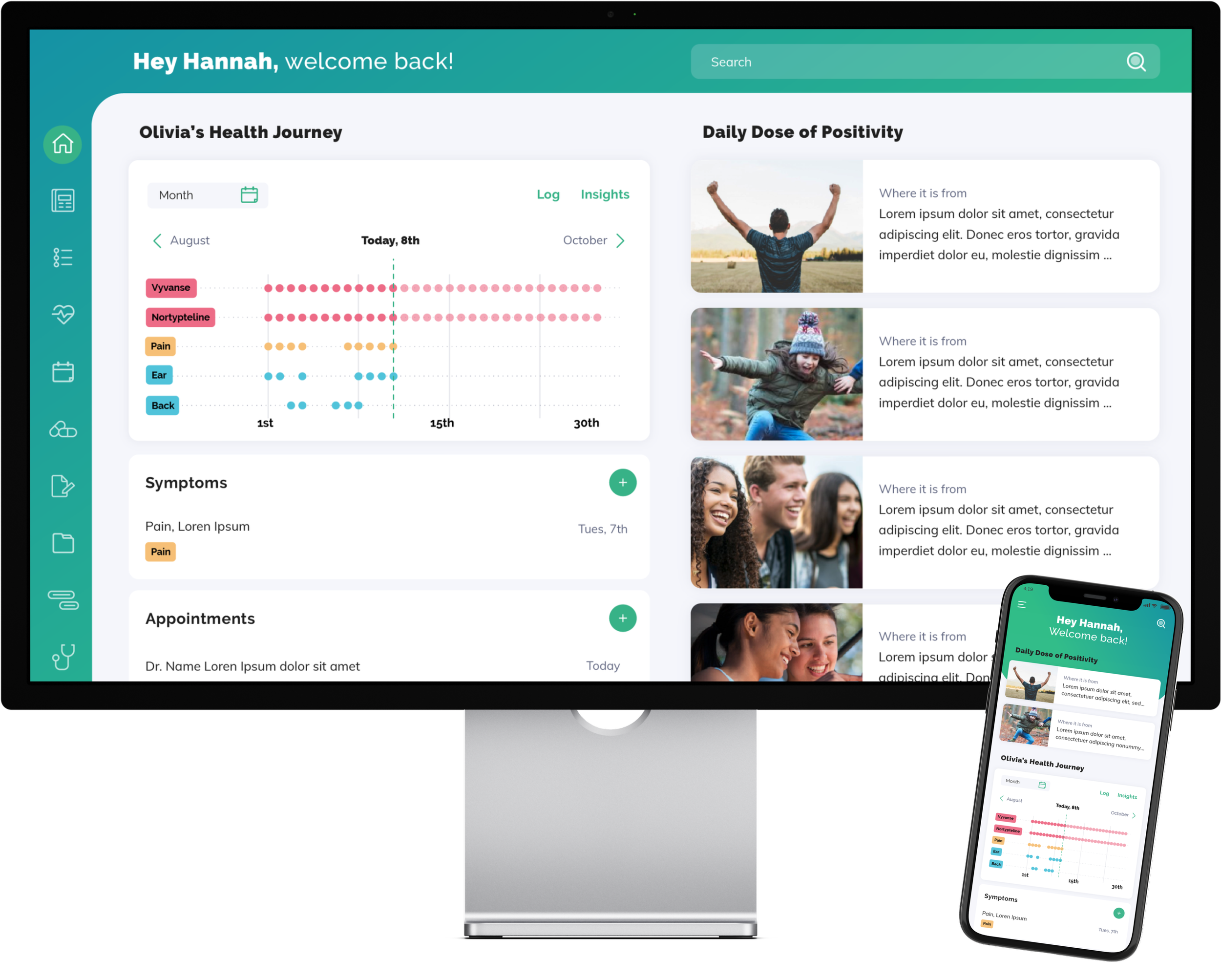
Homepage: Displays key sections with large, clearly labeled “Add” buttons — reflecting the app’s focus on data entry and ongoing tracking.
Menu Navigation: A hamburger menu on mobile mirrors the sidebar on desktop, allowing quick access to all sections (Health Journey, Appointments, Medications, Symptoms, Files, and the “Daily Dose of Positivity”).
User Roles: The system supports multiple roles—caregivers, patients, doctors, and educators—with different permission levels. This structure enables caregivers to manage a child’s profile early on, and later transfer ownership when the patient is ready to take control.
Health Journey: Log and Insights
At the heart of the experience is Olivia’s Health Journey, the main hub for reviewing all entries, including medications, appointments, symptoms, and activities, through two primary views:
Log View: A chronological, scrollable record of all entries, displayed as a visual timeline.
Insights View: Surfaces meaningful trends, highlighting relationships between symptoms, medications, and lifestyle activities.
Example: “You logged ringing in your ear 181% more frequently this month than last month.”
Insights are color-coded (green for positive, red for concerning) and paired with short, encouraging statements.
This dual approach helps users and their doctors see progress, patterns, and triggers without feeling overwhelmed by data.
Trackers & Data Visualization
Every entry connects to one or more Trackers, which act as a unifying thread across the app.
Tracker Categories: Symptoms, Medications, Activities, Moods, Doctors, Files, and Appointments, each assigned a color for instant visual recognition.
Frequency & Correlation: Insights are generated by comparing tracker frequency over time or identifying correlations between events (e.g., pain spikes after certain activities).
Saved Tracker Groups: Users can group trackers, such as “Pain,” “Ear,” and “Ringing in ears,” to monitor specific symptom clusters over time.
Controls & Date View
The Date View Control allows users to filter and review information by custom timeframes (week, month, etc.), making it easier to focus on recent changes or long-term progress.
Adding Entries
The Add a Symptom flow was designed to make logging quick and meaningful:
Large, easily accessible “+” buttons throughout the interface.
Step-by-step entry flow for selecting symptom categories and intensity.
Option to add photos or notes for context.
Entries can be linked to upcoming appointments, creating a cohesive record for the medical team.
Onboarding & Guidance
The Onboarding flow ensures users set up their accounts intuitively:
Caregivers can create new patient profiles or connect to existing ones.
Early screens collect essential data to avoid duplicate profiles.
Optional tutorials within the menu help users understand complex features like trackers or insights — promoting adoption and confidence.
Users can link their email/calendar for notifications, appointment reminders, and medication alerts.
Look and Feel
The visual design embodies the project’s emotional intent—Hopeful, Friendly, and Supportive.
Soft colors, rounded edges, and clear hierarchy guide users effortlessly.
Simple iconography paired with plain-language labels reinforces trust and ease.
The “Daily Dose of Positivity” section highlights encouraging updates, clinical breakthroughs, and community stories, promoting optimism in an often overwhelming health journey.
Accessibility & Inclusivity
Given the cognitive and visual challenges associated with NF, the interface emphasizes:
High-contrast text and large tap targets.
Minimalist navigation to reduce cognitive load.
Clear visual affordances for primary actions.
Impact
The final design provides patients and caregivers with a unified health management hub, bridging fragmented records, surfacing actionable insights, and connecting them with reliable information and hope.
By blending data organization with emotional design, The Meeting Spot transforms the NF experience from reactive to proactive, helping users not just manage the disease but live with greater understanding and optimism.
Although formal user testing has not yet been conducted, early feedback from APNF and UEGroup stakeholders was highly positive. The concept was praised for its clarity, empathy, and potential to meaningfully support families affected by NF.
Stakeholders highlighted:
Clarity and Organization: Simplifies complex medical data into a clear, navigable structure.
Empathetic Tone: A hopeful visual language and the Daily Dose of Positivity reduce emotional fatigue.
Comprehensive Vision: Bridges caregivers, patients, and clinicians in a single connected platform.
Scalable Framework: Flexible, role-based design adaptable for clinicians and researchers.
Mission Alignment: Directly supports APNF’s goals to expand awareness, accessibility, and patient support.
Though early in its lifecycle, the concept has laid a strong foundation for future testing, iteration, and launch, marking a key step toward empowering patients and caregivers to take control of their health journeys with confidence.
Next Steps
With concept validation from APNF complete, the following next steps were recommended to move the project toward development and implementation:
User Testing & Iteration
Conduct usability testing with caregivers, patients, and healthcare professionals to validate navigation flows, accessibility, and data comprehension.
Incorporate feedback to refine task flows (e.g., adding symptoms, logging appointments, viewing insights).
Technical Planning & Compliance
Collaborate with healthcare developers to define architecture for HIPAA and GDPR compliance.
Establish data storage, encryption, and role-based access protocols to ensure patient privacy.
Integration Exploration
Investigate integration with calendar, email, and health systems for real-time syncing of appointments and medical updates.
Assess interoperability with hospital EMRs and NF clinic databases.
Community Development
Build out moderated forums or message boards to safely connect patients, caregivers, and advocacy groups.
Integrate content feeds from verified NF organizations to keep educational materials and research updates current.
Scalability & Localization
Begin localization for English and Portuguese audiences to support APNF’s global user base.
Plan for expansion into European and U.S. NF communities through partnerships with major NF networks.